
LED Strip NeoPixel RGB - 60 LEDs / 1m black - 1 meter Adafruit 1461
Product information:
Adafruit's 32-LEDs-per-meter RGB strips were already very popular, now there are even strips with 60 LEDs per meter!
The strips have also become narrower, 12.5mm and even 10mm if you remove the protection! To make the strips less noticeable, they are now also available with a black background.
These are not just any RGB LED strips, this one has 60 RGB LEDs per meter and you can control them individually! You can digitally address each LED! You can set the red, blue and green color of each LED with 8 bit PWM precision (so 24 bits per pixel).
The LEDs are controlled by shift registers that are looped through the strip so you can make the strip longer or shorter. Only 1 digital output pin is needed to send data. The PWM is built into each LED chip so after setting the color and brightness you don't have to 'talk' to it anymore. The setting is automatically retained.
The strip is made of flexible PCB material and comes with waterproof protection. You can cut this quite easily with a pair of wire cutters. You can cut the strips every 1.7cm (per LED). Solder your wiring to the 2.5mm copper contacts and you are done. You can of course connect as many strips as you like to make them longer, you just have to watch how much current it draws!
A 5V/2A power supply is usually suitable for 1 meter, a 5V/10A power supply for 4 meters, depending on use. You must use a 5V power supply, at higher than 6V the entire strip will be destroyed.
What you should pay attention to with these super LED strips:
- First, the higher density means more power consumption per meter - 18 Watts max (~3.5A @ 5V) per meter instead of 9.6 Watts max (~2A @ 5V). The maximums assume all LEDs are burning at full strength in white. On average, it will be a third to a half of the maximum for a colorful design. A good 5V power supply is essential!
- Second, to get the higher density the driver chip has a single pin for input and a single pin for output. The protocol used for the driver is very timing specific and can therefore only be driven by microcontrollers with 100nS timing precision. There are example programs for the Arduino UNO and Mega microcontrollers at 8 and 16 MHz, but it will not work on Raspberry Pi's, Basic stamps, NETduino's or other interpreted/virtual machine microprocessors or other processors slower than 8MHz. For those processors you might want to look at 32 LED/meter strips with SPI-like input/output.
- Third, just because you have the pixels doesn't mean you have the RAM - the entire strip needs to be buffered in memory. Many Arduino UNO projects often only have 1500 bytes left when everything is loaded: good for about 500 LED pixels. If you want to control more LEDs, look at an Arduino Mega.
Specifications:
- 12.5mm wide, 4mm thick, 16.7mm long per segment
- 60 LEDs per meter
- Removable IP65 weatherproof housing
- Maximum 5V @ 60mA current per 1.65cm strip segment (all LEDs at highest brightness)
- voltage 5VDC (do not exceed 6VDC)
- no polarity protection
- 1 integrated RGB LED per segment, individually controllable
- LED wavelengths: 630nm/530nm/475nm
Please note! The strips are supplied by Adafruit on a roll. They are cut to size. It is possible that there are no connectors on it, because they are only at the beginning and end of the roll.
 Click to view the product's website.


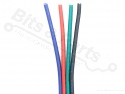 Wire for connecting RGB LEDs 0.35mm² 22AWG per meter
1,75
Wire for connecting RGB LEDs 0.35mm² 22AWG per meter
1,75
 Silicone work mat 34cm x 23cm x 5mm blue
9,95
Silicone work mat 34cm x 23cm x 5mm blue
9,95
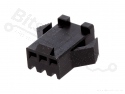 Connector JST SM 3 pin female
0,65
Connector JST SM 3 pin female
0,65
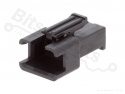 Connector JST SM 3 pins male
0,65
Connector JST SM 3 pins male
0,65
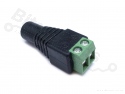 Power jack plug Female DC 2,1x5,5mm with block terminal connection
1,25
Power jack plug Female DC 2,1x5,5mm with block terminal connection
1,25
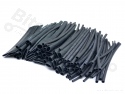 Heat shrink tubing assortment 100 pieces black
3,95
Heat shrink tubing assortment 100 pieces black
3,95
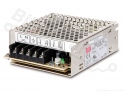 Power supply 5 Volt / 10A DC industrial Meanwell RS-50-5
21,95
Power supply 5 Volt / 10A DC industrial Meanwell RS-50-5
21,95
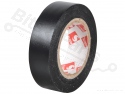 Electrical insulation tape PVC 10mx15mm black
1,50
Electrical insulation tape PVC 10mx15mm black
1,50
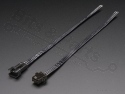 Cable set JST SM 3 pins - Adafruit 1663
2,95
Cable set JST SM 3 pins - Adafruit 1663
2,95
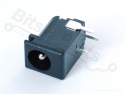 Chassis part 2.1x5.5mm power plug jack plug breadboard friendly
1,75
Chassis part 2.1x5.5mm power plug jack plug breadboard friendly
1,75


 Shipping costs Netherlands




 >
>
