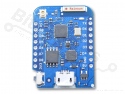
WeMos D1 mini - ESP8266 WiFi development board - USB-C
Product information:
Getting an electronics project online has never been easier!
All pins of the ESP-8266 are available for making circuits.
Various shields are available for the board (see additional articles) to expand its functionality.
Easy upload of programs through the USB-C connection (cable not included).
The ESP-8266 on the WeMos D1 mini can be programmed using either the Arduino IDE development environment or the NodeMCU Lua programming language. (See the website link for tutorials on both options.)
The WeMos D1 mini has a CH340G chip on board for serial communication with a PC or Mac. The drivers for this (if the computer does not recognize it yet) are under the heading documentation. The board will be visible in the development environment as an extra COM/ttyS port.
Specifications:
- 11 digital input/output pins
- 1 analog input (3.2V max.)
- all pins have interrupt/PWM/I2C/One-wire support (except pin D0).
- micro USB connection
- reset button
- on board LED (on D4)
- signal level on all pins: 3.3V
- compatible with Arduino IDE (automatic upload)
- compatible with NodeMCU
- clock speed: 80MHz/160MHz
- flash memory: 4M bytes
- dimensions: 34.2mm x 25.6mm x 6.7mm
- weight: 3.9g (without pins) / 10g
Pinout:
| Pin | Function | ESP-8266 Pin |
| TX | TXD | TXD |
| RX | RXD | RXD |
| A0 | Analog input, max 3.2V input | A0 |
| D0 | IO | GPIO16 |
| D1 | IO, SCL | GPIO5 |
| D2 | IO, SDA | GPIO4 |
| D3 | IO, 10k Pull-up | GPIO0 |
| D4 | IO, 10k Pull-up, BUILTIN_LED | GPIO2 |
| D5 | IO, SCK | GPIO14 |
| D6 | IO, MISO | GPIO12 |
| D7 | IO, MOSI | GPIO13 |
| D8 | IO, 10k Pull-down, SS | GPIO15 |
| G | Ground | GND |
| 5V | 5V | - |
| 3V3 | 3.3V | 3.3V |
| RST | Reset | RST |


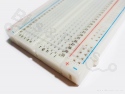 Breadboard 400 pins MB102 - universal experimenting board white
2,95
Breadboard 400 pins MB102 - universal experimenting board white
2,95
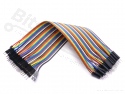 Breadboard jumper cables Dupont 20cm male/male 40PCS
1,85
Breadboard jumper cables Dupont 20cm male/male 40PCS
1,85
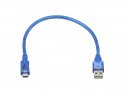 USB Connection Cable USB A <-> USB C 0.3 meters
0,85
USB Connection Cable USB A <-> USB C 0.3 meters
0,85
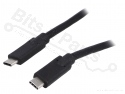 USB Connection Cable USB C to USB C 1.0m (USB 3.1)
7,95
USB Connection Cable USB C to USB C 1.0m (USB 3.1)
7,95
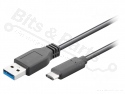 USB Connection Cable USB A <-> USB C 3.0 - 2 meters
10,95
USB Connection Cable USB A <-> USB C 3.0 - 2 meters
10,95
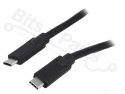 USB Connection Cable USB C to USB C 1.5m (USB 3.2)
9,95
USB Connection Cable USB C to USB C 1.5m (USB 3.2)
9,95
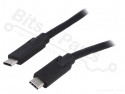 USB Connection Cable USB C to USB C 2m (USB 3.1)
11,95
USB Connection Cable USB C to USB C 2m (USB 3.1)
11,95
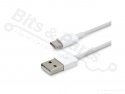 USB Connection Cable USB A <-> USB C 0.5 meter white
2,95
USB Connection Cable USB A <-> USB C 0.5 meter white
2,95
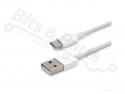 USB Connection Cable USB A <-> USB C 1.0 meter white
3,95
USB Connection Cable USB A <-> USB C 1.0 meter white
3,95


 Shipping costs Netherlands



 >
>
